- Benzinga Advisor
- Posts
- Fed Report: Financial Anxiety Hits Highest Level Since 2022
Fed Report: Financial Anxiety Hits Highest Level Since 2022
Plus, the latest in market news.


Happy Sunday, and welcome to Benzinga’s financial advisor newsletter.
Today we're discussing affordability. A new Federal Reserve report revealed a shift in household sentiment that hasn't been seen in years, adding to a growing list of warning signs facing American consumers. Read on for all the details.
Plus, a look at all the top stories and market activity from this past week.
Advisor Spotlight: If you would like your company to be featured in our upcoming Advisor Spotlight, click here to send us an email.
INDUSTRY CHATTER

Over the past few weeks, we've highlighted several reports that Americans are growing increasingly uneasy about their financial future.
A recent Gallup survey found that affordability remains the nation's top financial concern for the fifth year in a row, while a separate study from TIAA Institute showed financial literacy falling to an all-time low. In addition, reports showed that more Americans are "unretiring" to keep up with rising living costs, and the latest data from the Federal Reserve confirms that as households say their financial situation is deteriorating.
That shift — which has grown since the start of the year — is now reaching levels not seen since the height of the pandemic. According to the Fed's latest Survey of Consumer Expectations, the share of households that say their financial situation is "much worse" than it was a year ago, climbed to 13.3% in May, the highest reading since July 2022. Another 43.7% said their finances are somewhat worse than a year ago — the highest since January 2023.
Perhaps more concerning is what households expect next. More than one-third of respondents believe their financial situation will worsen over the coming year, while fewer than one-quarter expect improvement.
The gap between optimism and pessimism is now the widest it has been since 2022. What's notable, is that inflation expectations have remained stable too. Consumers are not suddenly forecasting a new inflation spike, instead, many appear to be reacting to the cumulative effect of several years of elevated prices, higher borrowing costs, and ongoing economic uncertainty. Even if inflation is no longer accelerating, many households still feel as though they're falling behind.
The behavioral implications are worth watching. When people feel financially stressed, they often become more conservative with spending, delay major purchases, increase savings, or focus more heavily on short-term concerns. Those shifts can occur even when employment remains strong and investment portfolios have recovered. Meanwhile, younger households continue to face high housing costs and affordability challenges, while retirees and near-retirees are more sensitive to rising everyday expenses. In both cases, perception can influence decision-making just as much as reality.
For advisors, perhaps the most important takeaway is not any single survey result but the broader pattern emerging across multiple studies. Affordability concerns remain elevated, financial literacy is declining and more retirees are returning to work. And now, households are expressing the most negative views of their finances in nearly four years.
Viewed together, these trends suggest that many clients may be carrying more financial stress than their balance sheets alone would indicate. Advisors who recognize that disconnect may be better positioned to address concerns before they become problems, helping clients separate short-term anxiety from long-term financial reality. In an environment where confidence is weakening, providing reassurance and perspective is one of the most valuable services advisors can provide.
SPONSORED CONTENT

SpaceX (Ticker: SPCX) began trading on the Nasdaq this month. Behind the ticker is the mammoth company that launches most of the world's rockets and runs Starlink, the satellite network with more than 10,000 satellites in orbit.
A stock this big and this new doesn't trade quietly. Now there's a leveraged way to trade it.
Introducing the Direxion Daily SpaceX Bull 2X ETF (LOFF). LOFF seeks 200% of the daily performance of SPCX. It is built for active traders making short-term, daily-objective trades. Held longer than one day, its returns can differ significantly from 2X the underlying stock. Significant Risk Involved.
This is a paid ad. Please read the 17b disclosure here.
WEEKLY MARKET RECAP

U.S. stocks rebounded Thursday, led by a sharp rally in semiconductors, as a signed U.S.-Iran peace deal sent oil tumbling and an Intel-Apple chip manufacturing pact lit a fire under technology shares.
The rebound came one day after stocks slumped when the Federal Reserve – in Kevin Warsh‘s first meeting as chair – held its benchmark rate at 3.50%-3.75% but raised its inflation outlook and signaled a growing bias among officials toward hiking later this year.
Crude extended its slide after the U.S. and Iran signed a 14-point memorandum of understanding to extend the ceasefire and reopen the Strait of Hormuz, where three Saudi-flagged supertankers transited hours after the deal.
West Texas Intermediate crude fell 2.2% to around $75 a barrel, while Brent slipped 1.5% to roughly $78. Oil has now dropped about 14% over five sessions to its lowest level since the conflict began, dragging the national average gasoline price below $4 a gallon for the first time since March.
Across U.S. equity markets by midday Thursday, gains were concentrated in megacap technology, with the rest of the tape mixed. The S&P 500 rose 1.2% to about 7,505, while the Dow Jones Industrial Average added 0.8% to near 51,905.
The Nasdaq 100 outperformed, climbing 1.5% to around 30,116 as chipmakers led the charge. The Russell 2000 bucked the trend, falling 0.7% to roughly 2,897 as small caps stayed pressured by the prospect of higher-for-longer interest rates.
Chipmakers Soar On Intel-Apple Deal
The Technology Select Sector SPDR Fund (XLK) led all S&P 500 sectors with a 2.8% gain as the semiconductor complex roared back, followed by the Utilities Select Sector SPDR Fund (XLU), up 1.8%. On the downside, the Energy Select Sector SPDR Fund (XLE) was the clear laggard, falling 2.0% with crude, while the Health Care Select Sector SPDR Fund (XLV) slid 1.2%.
The VanEck Semiconductor ETF (SMH) surged 5.4% to pace all industries, with the iShares U.S. Home Construction ETF (ITB) up 4.1% and the U.S. Global Jets ETF (JETS) up 2.5% as airlines welcomed cheaper fuel.
At the bottom, the energy patch was hammered: the VanEck Oil Services ETF (OIH) tumbled 3.8%, the SPDR S&P Oil & Gas Exploration & Production ETF (XOP) fell 2.1%, and the VanEck Gold Miners ETF (GDX) dropped 2.0% as bullion retreated.
Intel (INTC) surged roughly 9.8% after President Donald Trump said on Truth Social that Apple (AAPL) had agreed to work with Intel to design and build its chips in America, a pact that would extend Intel’s more than 400% run since Washington’s 2025 investment in the chipmaker.
Peers rallied in sympathy, with Advanced Micro Devices (AMD) up 3.9%, Broadcom up 3%, and Micron (MU) up 4.8% ahead of its results this week.
Marvell (MRVL) climbed 12.1% and Astera Labs (ALAB) added 11.5%, both riding the AI-silicon rally. SanDisk (SNDK) rose 11.0% on the strength in memory pricing.
The downside was a near-wholesale repricing of IT services. Accenture (ACN) plunged 17.4% after the consulting giant cut its fiscal-year revenue-growth guidance, citing cautious enterprise spending and a slowdown in its U.S. federal business.
BENZINGA NEWSLETTER SPOTLIGHT
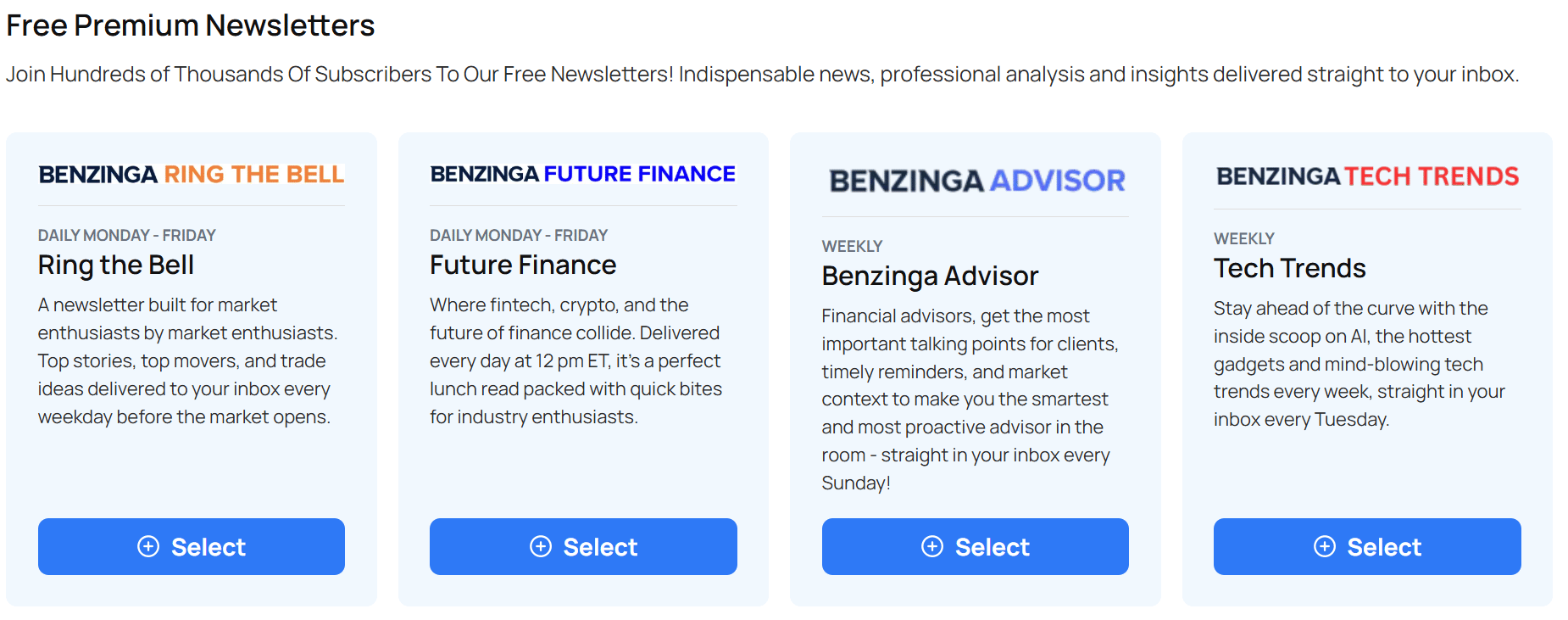
Want more of the news and insights you love? Join hundreds of thousands of readers and explore our other free newsletters for market updates, expert insights, and must-read stories delivered straight to your inbox.
Ring The Bell: Created for market enthusiasts by market enthusiasts, this twice-daily newsletter delivers top stories, fast movers, and hot trade ideas straight to your inbox. Sign up today.
Future Finance: Where fintech, crypto, and the future of finance collide. Future Finance is a perfect lunch read packed with quick bites for industry enthusiasts. Subscribe here.
Tech Trends: Get the inside scoop on AI, the hottest gadgets, and mind-blowing tech trends. Join today.
THE WEEK AHEAD

Economic Data
Monday: Fed Speech, 3-month and 6-month bill auction
Tuesday: S&P Global Services PMI, ADP Employment, API Weekly Crude Oil Stock
Wednesday: Crude Oil Inventories, New Home Sales, Building Permits
Thursday: Jobless claims, PCE, GDP, Durable Goods Orders
Friday: Total rig count, retail inventories, Fed speeches (Kashkari, Williams)
Earnings
Monday: Fervo Energy, Outdoor Holding Company
Tuesday: FedEx, Cerebras Systems, Carnival, KB Home
Wednesday: Micron, Trip.com, Paychex, Novagold Resources
Thursday: Darden Restaurants, TD Synnex, McCormick
Friday: No major earning reports
Click here for the full calendar of economic data and earnings reports.
Reminder, if you would like to be featured in our upcoming Advisor Spotlight and showcase your business, click here to send us an email.
BEFORE YOU GO
Were you forwarded this email? Click here to subscribe.
And be sure to check out our other newsletters:
Ring The Bell: Created for market enthusiasts by market enthusiasts, this twice-daily newsletter delivers top stories, fast movers, and hot trade ideas straight to your inbox. Subscribe here.
Future Finance: Where fintech, crypto, and the future of finance collide. Future Finance is a perfect lunch read packed with quick bites for industry enthusiasts. Subscribe here.
Tech Trends: Get the inside scoop on AI, the hottest gadgets, and mind-blowing tech trends. Subscribe here.