- Benzinga Advisor
- Posts
- The Hidden Debt Your Clients Aren’t Telling You About
The Hidden Debt Your Clients Aren’t Telling You About
Plus, the latest in market news.


Happy Sunday, and welcome to Benzinga’s financial advisor newsletter.
Today we’re talking about consumer debt that many clients aren’t likely bringing up or talking about. Buy now, pay later services aren’t just about convenience anymore, see what the rapid rise could reveal about your clients’ real financial picture.
Plus, a look at all the top stories and market activity from this past week.
Advisor Spotlight: If you would like your company to be featured in our upcoming Advisor Spotlight, click here to send us an email.
Table of Contents
INDUSTRY CHATTER

Last month, we looked at the rise in “unretiring” as more Americans head back to work to keep up with the cost of living. It was a clear signal that financial pressure isn’t confined to one generation. For some, it shows up after retirement, and others, much earlier and in subtle ways.
One of those places is buy now, pay later services (BNPL).
A new report from LendingTree found that 47% of BNPL users paid late on at least one loan in the past year, up from 41% last year and 34% in 2024. More than half of users (54%) say they wouldn’t be able to make ends meet without BNPL. What was marketed as a convenience tool is increasingly being used as a financial bridge.
The way it’s being used reinforces that shift. Nearly 30% of users have financed groceries with BNPL — more than doubling in the past two years. Among Gen Z, that figure rises to 38%, making it the second-most-common purchase. Additionally, 25% of users report having three or more BNPL loans open simultaneously.
This isn’t just occasional use. It’s stacking.
For advisors, that distinction matters. BNPL often sits outside traditional balance sheet conversations. It may not show up clearly on a credit report, and clients don’t always think to mention it alongside credit cards or loans. But it still represents future cash flow obligations competing for the same dollars.
There’s also a behavioral element that’s easy to overlook. Most users say they choose BNPL for convenience and ease of access, not because it’s interest-free. In other words, the appeal isn’t cost savings. It’s low friction. And low friction cuts both ways.
Nearly 70% of users say BNPL leads them to overspend, and more than half report some level of regret. When repayment is fragmented into smaller pieces — and spread across multiple purchases — it becomes harder to track the full picture.
What’s notable is how broad this trend is. Millennials, many in their peak earning years, report high reliance on BNPL to manage monthly expenses. Even higher-income households — those making more than $100,000 — are using it, suggesting this isn’t purely an income issue, it’s about spending patterns and liquidity management. Just like the “unretiring” trend, this is less about the product itself and more about what it signals.
So what’s the takeaway for advisors? Don’t overlook BNPL, view it as an early signal. It’s often one of the first places financial strain shows up because it’s easy, fast, and mostly invisible. Asking a client if they are using any buy now, pay later services can open the door to a much deeper conversation about cash flow, spending habits, and hidden obligations.
The goal isn’t necessarily to eliminate BNPL use, but to surface it early enough that clients are making deliberate choices — not quietly relying on it to stay afloat.
SPONSORED CONTENT

Many industries from AI to defense rely on rare earth materials, and vulnerability to a supply chain disruption remains a looming possibility – prompting governments to support strengthening Western supply chains.
China processes the bulk of rare earth materials, and Chinese companies are usually a significant part of the largest rare earths-focused ETF portfolios, introducing a geopolitical risk.
But there is a rare-earth ETF.
The recently launched Sprott Rare Earths Ex-China ETF (REXC) is a fund aiming to provide exposure to the rare earth materials industry while excluding companies located within China. It invests in the companies that generate at least 50% of their revenues from the rare earth and strategic metals segment.
To learn more, click here.
This is a paid ad. Please read the 17b disclosure here and the footnote.

The Strait of Hormuz reopened and Wall Street smashed all records, in what became a historic week for the books.
Weeks of war, inflation fears and $100 crude culminated Friday in a sequence of announcements that traders had been waiting for since February 28, when the U.S. and Israel initiated coordinated military operations against Iran.
Iranian Foreign Minister Abbas Araghchi declared the waterway completely open for all commercial vessels for the remaining period of the ceasefire. President Donald Trump followed with a flurry of posts on Truth Social, claiming credit for the opening and closing the sequence with the most consequential line of the day: Iran had agreed to never close the strait again.
“It will no longer be used as a weapon against the World,” Trump wrote on social media. According to Axios, citing unnamed sources, the U.S. is considering releasing $20 billion in frozen Iranian funds so long as Iran gives up its stockpile of enriched uranium.
Oil plunged 15% to around $80 a barrel by midday Friday. WTI crude is now down 27% in two weeks — its worst two-week decline since April 2020 — as traders priced out the supply shock that had defined the first quarter.
The S&P 500 — as tracked by the SPDR S&P 500 ETF Trust (SPY) — crossed 7,100 for the first time in its history, posting its third consecutive week of gains and rising 12% over that stretch, the best three-week performance since April 2020.
The Nasdaq 100 — as tracked by the Invesco QQQ Trust (QQQ) — reached 26,700, extending its winning run to 13 consecutive sessions. A streak of that length has occurred only four times in the index’s history since 1985, and only once since 2013. The 13-day advance also ranks as the strongest since the pandemic rebound of April 2020.
Table: Historical Episodes Of Nasdaq 100 Making A 13-Day Consecutive Rally

Source: TradingView – Event Study: Forward Return Analyzer for NDQ (13-day winning streak)
Small caps joined the rally. The Russell 2000 hit a record at 2,780, up 15% over 13 sessions, closing in the green every single day of the week.
The week’s biggest winners within the S&P 500 reflected a broad return of risk appetite. Robinhood (HOOD) surged 32%. Oracle (ORCL) rose 30% — its best week since 1999. Coinbase (COIN) added 25% as crypto names rallied alongside growth stocks.
Bitcoin (BTC) rallied to $78,000 on Friday, and was up over 10% for the week – on pace for its best weekly performance since November 2024.
The biggest losers were last month’s biggest winners. Energy names bore the brunt of crude’s collapse.
APA (APA), Devon Energy (DVN) and Coterra Energy (CTRA) each fell roughly 10% on the week as the war premium that had defined the first quarter began to unwind in earnest.
Michigan’s automakers extended their own recovery. General Motors (GM) rallied 7.7%, its best weekly performance since October 2025. Ford Motor (F) gained 7%, notching its third consecutive week of gains.
The ceasefire expires April 21. Talks between Washington and Tehran resume Sunday in Islamabad.
On Wall Street, the math was simple: peace is good for business.
BENZINGA NEWSLETTER SPOTLIGHT
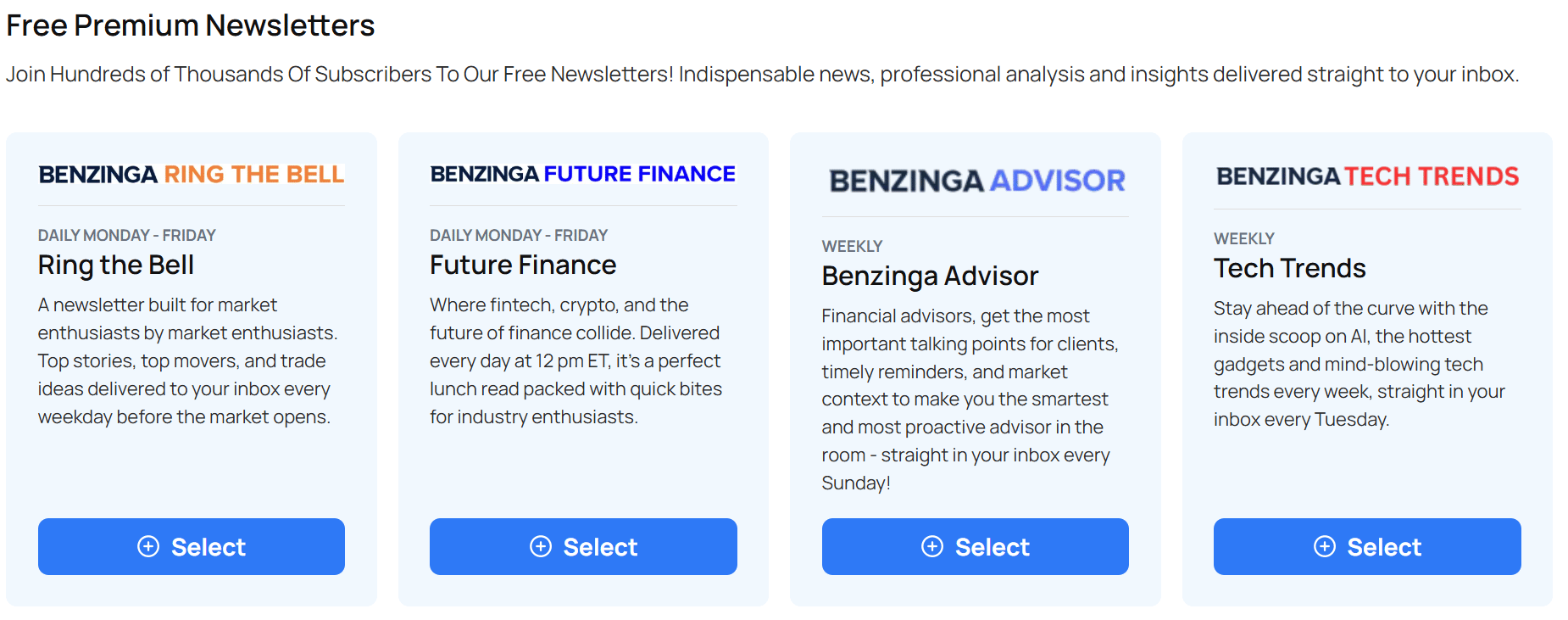
Want more of the news and insights you love? Join hundreds of thousands of readers and explore our other free newsletters for market updates, expert insights, and must-read stories delivered straight to your inbox.
Ring The Bell: Created for market enthusiasts by market enthusiasts, this twice-daily newsletter delivers top stories, fast movers, and hot trade ideas straight to your inbox. Sign up today.
Future Finance: Where fintech, crypto, and the future of finance collide. Future Finance is a perfect lunch read packed with quick bites for industry enthusiasts. Subscribe here.
Tech Trends: Get the inside scoop on AI, the hottest gadgets, and mind-blowing tech trends. Join today.
THE WEEK AHEAD

Economic Data
Monday: No major reports
Tuesday: Retail sales, Leading economic indicators, Pending home sales
Wednesday: Crude oil inventories, 20-Year bond auction
Thursday: Initial jobless claims, S&P flash services/manufacturing PMI
Friday: Consumer sentiment, Rig count
Earnings
Monday: Steel Dynamics (STLD), Zions Bank (ZION), Alaska Air (ALK)
Tuesday: UnitedHealth (UNH), Intuitive Surgical (ISRG), Figma (FIG), Northrop Grumman (NOC), United Airlines (UAL)
Wednesday: Tesla (TSLA), Lam Research (LRCX), Boeing (BA), IBM (IBM), Texas Instruments (TXN), ServiceNow (NOW),
Thursday: Intel (INTC), American Express (AXP), Lockheed Martin (LMT),
Friday: Procter & Gamble (PG), HCA Healthcare (HCA), Colgate (CL)
Click here for the full calendar of economic data and earnings reports.
Reminder, if you would like to be featured in our upcoming Advisor Spotlight and showcase your business, click here to send us an email.
BEFORE YOU GO
Were you forwarded this email? Click here to subscribe.
And be sure to check out our other newsletters:
Ring The Bell: Created for market enthusiasts by market enthusiasts, this twice-daily newsletter delivers top stories, fast movers, and hot trade ideas straight to your inbox. Subscribe here.
Future Finance: Where fintech, crypto, and the future of finance collide. Future Finance is a perfect lunch read packed with quick bites for industry enthusiasts. Subscribe here.
Tech Trends: Get the inside scoop on AI, the hottest gadgets, and mind-blowing tech trends. Subscribe here.